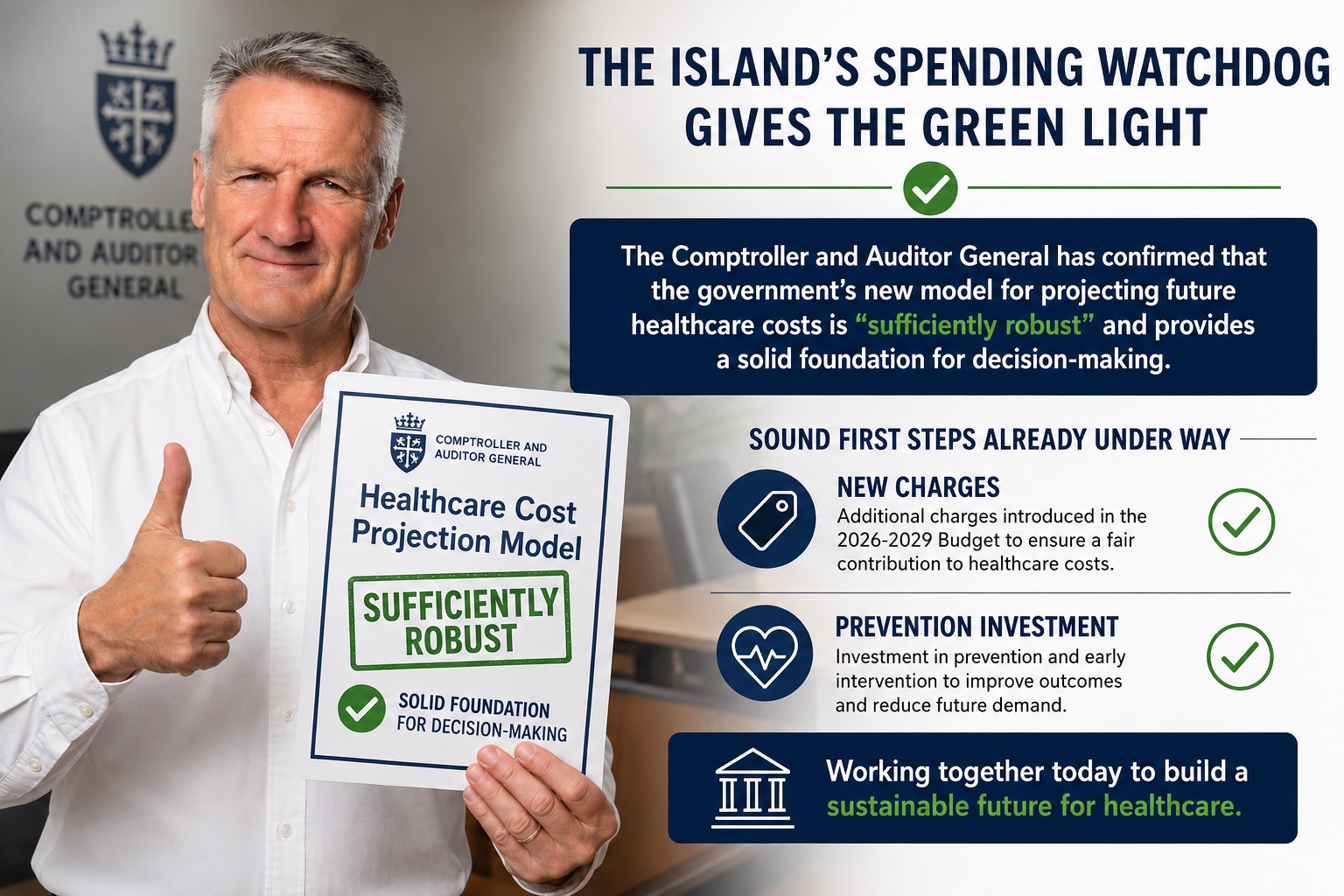
Jersey's Healthcare Funding Model Given the Green Light by Independent Auditor
The Island's spending watchdog has confirmed that the government's new model for projecting future healthcare costs is "sufficiently robust" and provides a solid foundation for decision-making. The Comptroller and Auditor General's report, published this week, credits work already under way — including new charges and prevention investment in the 2026-2029 Budget — as sound first steps toward putting healthcare funding on a sustainable footing. It sounds, on the surface, like a good-news story. Government has a working model. Officials are already taking action. The auditor isn't picking holes in the numbers. Read past the headline finding, though, and the same report sets out — in the auditor's own words — a scale of financial and structural risk that ought to concern every Islander, along with a list of questions this government has not yet answered.
The number that should stop you
Health spending swallowed 29% of total government expenditure in 2024 — a higher share than any OECD country, more than ten percentage points above the UK. Even before this report, an independent forecast commissioned by government put the future price tag in stark terms: by 2043, total healthcare expenditure is projected to hit £1,296 million, outstripping healthcare revenue by close to 40%. The gap between what the Island spends on health and what it brings in to pay for it was forecast at £298 million a year. The auditor's own updated modelling, without factoring in any new policy action, shows costs on track to keep growing at just under 3% a year, compounding. The question: if this trajectory has been visible since at least 2023, and government has known the size of the gap for that long, what specifically has been done to close it — and by how much has that gap actually narrowed since the forecast was published?
New charges — but not designed to raise money
Government is introducing new fees this year, including charges for Emergency Department use and for missed appointments. It would be reasonable to assume these exist to help plug the funding gap above. They don't. The auditor is explicit that these charges are "not intended to generate significant funding" — they're behavioural tools, meant to nudge how people use services, not a revenue plan. The question: if the current suite of charges isn't meant to raise meaningful money, what is the actual plan to close a £298 million gap — and when will Islanders see it?
Enforcement is planned to be "light touch"
The report flags that enforcement of the new charging policies is planned to be relatively light touch, and warns this creates a real risk the policies won't achieve their intended effect, financially or in changing public behaviour. The question: if government already expects its own enforcement approach might not work, why proceed with it as designed rather than fixing that risk before rollout?
A 20-year history of initiatives that didn't finish
This is not the first attempt to solve healthcare funding. The report traces a line back to the Health and Social Care Modernisation Fund in 2002, through "A New Way Forward" in 2012, to the Jersey Care Model launched in 2018. The auditor notes there is no single document anywhere that pulls together the learning from these projects — many of which were started and then ceased, or never fully delivered. The question: with three previous strategies over two decades that didn't survive to completion, what is different about this attempt — and who is responsible for making sure it doesn't join the list?
Leadership churn at exactly the wrong time
Coverage of the report has highlighted a detail with real weight: Jersey's government has had five different chief executives in the past decade, and the Health Department has had five different chief officers since 2018. A funding strategy that needs to run for 20 years is being handed between leaders roughly every two. The question: what is actually in place to make sure this plan survives its next change of leadership, given none of the last three did?
Six unresolved problems, named by the auditor itself
The report identifies six areas that still need to be addressed together before any funding solution can work: constraints in the healthcare system, constraints in the social care system, the new hospital building programme, fragmented accountability across health and social care, how change is actually implemented in practice, and continuity of leadership. The question: is there a published timeline for addressing each of these six, with a named owner for each — or does raising them here count as addressing them?
Who is actually accountable?
The report raises a specific and pointed structural question of its own: whether a single minister should be made responsible for the Health Department, the Health Insurance Fund, and the Long-Term Care Fund together, rather than the current split. Right now, responsibility for the money and the care it pays for is divided. The question: if the auditor is asking whether accountability is too fragmented to work, why is that decision still open rather than settled?
The government's own response so far
Asked about the report, Health Minister Tom Binet said it contained "nothing we didn't already know," and questioned whether the Comptroller and Auditor General's role delivers value at all. Taken at face value, that response answers some of the questions above by implication: if the findings really were already known, then presumably the plans to address them already exist too. If so, this is a straightforward ask — publish them, with the dates and figures attached, and the story becomes a genuinely good one. If they don't yet exist, then "nothing we didn't already know" was never a defence. It was a description of exactly the problem the auditor was reporting on.
Discussion (0)
Log in to join the discussion
No comments yet. Be the first to discuss this article!