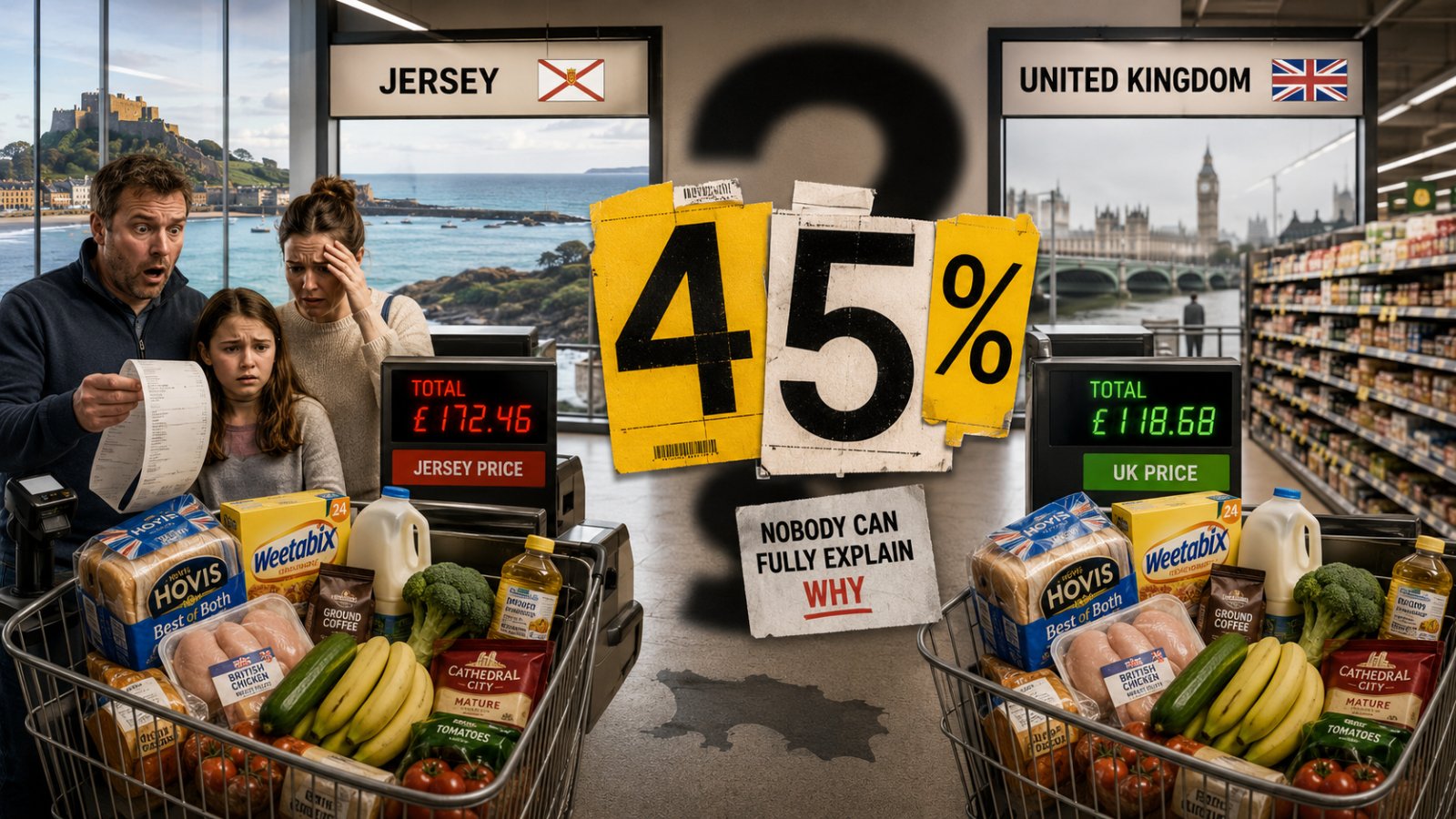
Islanders pay 45% more than UK shoppers at Morrisons. Nobody can fully explain why
A Consumer Council finding lands on the desk of a government elected on a promise to bring costs down — and the regulator's own numbers don't add up to the gap.
When Morrisons opened new stores in Jersey, the pitch to Islanders was simple: bigger stores, better prices. The Jersey Consumer Council decided to check. What it found, tucked into its newly published 2025 annual report, is a number that has stuck with Islanders ever since it first ran in the JEP: shoppers here are paying 45% more than their counterparts at Morrisons stores in the UK — for the same retailer, the same branding, often the same products. "During Q1 we continually heard from consumers who were concerned about high retail prices, in particular grocery prices," the Council writes. "The opening of the new Morrisons stores in the Island prompted us to carry out a price comparison of the new stores compared to the Sandpiper-run Morrisons Daily franchise." The first comparison undercut the marketing before the second one landed. Measured against the Sandpiper-operated Morrisons Daily stores they replaced, the new, directly-run Morrisons stores showed "little difference in price... despite being led to believe that the new stores would be cheaper." Then came the comparison against Morrisons' own stores in the UK: a 45% premium, on identical branding, at the same retailer. The Council says the finding "prompted a consistent response since from Islanders who were upset and dismayed at the high difference."
A new government, the same numbers
The report landed five weeks after Jersey went to the polls. The 7 June general election returned a States Assembly in which, across every campaign platform, one issue dominated: the cost of living — the single issue Islanders name most often as the most important facing the island, according to a January Policy Centre Jersey survey (38%, more than double the next-placed concern). When the new Council of Ministers was confirmed on 29 June, with Senator Lyndon Farnham reappointed as Chief Minister, he didn't pretend otherwise. "This is a moment of responsibility, not of celebration," Farnham told the Assembly. "The electorate has placed their trust in this assembly to deliver, and they will judge us not by our words today, but by the difference we make to their lives over the next four years... Islanders expect delivery now, not distraction." So: is 45% actually a solvable problem, or just geography? We went looking for the answer that already exists — Jersey's own competition regulator built one.
Our research: what the regulator says explains the gap
In September 2023, the Jersey Competition Regulatory Authority (JCRA) published a Groceries Market Study by Frontier Economics, built specifically to answer why island prices run higher. Comparing the same retailers in Jersey and the UK — its cleanest example was Co-op and Waitrose — it found UK prices were "c.12% cheaper." That 12% breaks down roughly like this:
Freight and distribution — about 7 points, the single biggest factor
UK retailers truck goods straight from depot to store. Jersey retailers add a leg: road to Portsmouth, then a ferry or freight ship across the Channel, then road again to the store. That's slower, more exposed to weather disrupting crossings, and means 80% of Jersey's food arrives imported, against 46% in the UK.
Labour — about 3 points
Jersey's minimum wage is now £13.59/hour, ahead of the UK's £12.71. A tight local labour market and high housing costs push general wages up, and the report notes a smaller quirk: French-sourced products sold through some retailers need manual relabelling for the local market.
Tax — about 2 points, and it cuts the opposite way most people assume
Jersey's 5% GST applies to groceries with no food exemption. The UK zero-rates most food under VAT. So Jersey taxes groceries and the UK largely doesn't — worth roughly 2% on the basket. It's live politics right now: the Channel Islands Co-op's chief executive, Mark Cox, publicly called on Jersey's government in late May to scrap GST on essential food, saying the change could be passed through "overnight" since pricing is centralised digitally. The Consumer Council pushed back, warning any saving would be "wiped out within a matter of weeks or months" by ongoing price rises, leaving government to recover the lost revenue elsewhere — Treasury's own analysis puts that at roughly a one-point rise in GST on everything else.
Property — about 1 point
Commercial rents running above the UK average. And, notably, not profit. The JCRA's explicit conclusion: "operating margins of Jersey grocery retailers were comparable to those of UK grocery retailers – in almost all cases less than 5% of prices... not making 'excess' profits." No Aldi, Lidl or UK "Big Four" discount format operates in Jersey at all — the study found that's a structural barrier (limited sites, planning refusals) rather than anything anticompetitive, in a market where the top three retailers already cover more than 70% of sales.
The gap the numbers don't cover
Add up freight, labour, tax and property, and the regulator's own methodology gets to roughly 12% for a like-for-like retailer — its real example being Co-op and Waitrose, Jersey against the UK. Even stretching the comparison to the entire UK "Big Four" average against the Jersey market average, the gap was 26%. Forty-five per cent is neither of those. It's not close. That leaves an honest, unresolved question sitting in the middle of this story: if freight, wages, tax and rent explain roughly 12 to 26 points of extra cost, what explains the other 20-plus? A few possibilities, none of them confirmed: The regulator's "no excess profit" finding rests on published UK group margins for Aldi, M&S, Sainsbury's and Morrisons — not on Jersey-specific accounts. A footnote in the report concedes as much: "We have not carried out a full economic profit analysis for Jersey retailers, given limited powers of data collection." Morrisons' Channel Islands stores are barely a year old, folded into a UK-wide company account that doesn't break out island performance — so nobody outside the business actually knows what margin is being taken on Jersey shelves specifically. It's also possible the gap has simply grown since 2023. Freight costs, minimum wage, and general inflation have all moved since the study was published, and it never covered Morrisons at all — the acquisition of the old Sandpiper estate only completed in November 2024. Or it may be specific to a chain still bedding in a new island operation, inheriting Sandpiper's old supply and cost base while trying to look and price like a mainland Morrisons.
What's next
The Consumer Council says it will keep tracking grocery prices fortnightly through 2026. The Cost of Living Ministerial Group — which the Council's chairman joined in 2025, presenting on grocery prices in August — is the forum where this now belongs. Voters have handed Farnham's team a four-year mandate built on bringing costs down; the Consumer Council has handed them a specific, well-evidenced number that the regulator's own framework can't fully account for. The obvious next step, and one nobody in Jersey appears to have done yet, is to ask Morrisons directly to explain the gap between the 12-26% the regulator's cost drivers predict and the 45% Islanders are actually paying.
Sources
- Jersey Consumer Council 2025 Annual Report (R.123/2026)
- JCRA Groceries Market Study
- Policy Centre Jersey, "Cost of Living" policy brief, June 2026
- Guernsey Press, "CI Coop boss calls on Jersey to remove GST on food,"
- Island FM, "Farnham's planned Council of Ministers confirmed,"
- WageIndicator, "Minimum wage revised in Jersey... from 1 April 2026"
- 2026 Jersey general election — Wikipedia
Discussion (0)
Log in to join the discussion
No comments yet. Be the first to discuss this article!