Four Months to Set the Course: The Common Strategic Policy, Past and Future
Every time Jersey elects a new Council of Ministers, the clock starts on one of the least-noticed but most structurally important obligations in the Island's constitution. Under Article 18(2)(e) of the States of Jersey Law 2005, the Council of Ministers must agree and lodge a statement of its Common Strategic Policy (CSP) for referral to Scrutiny Panels and approval by the States Assembly, and it must do so within four months of taking office, no later than the day it lodges its first Government Plan.
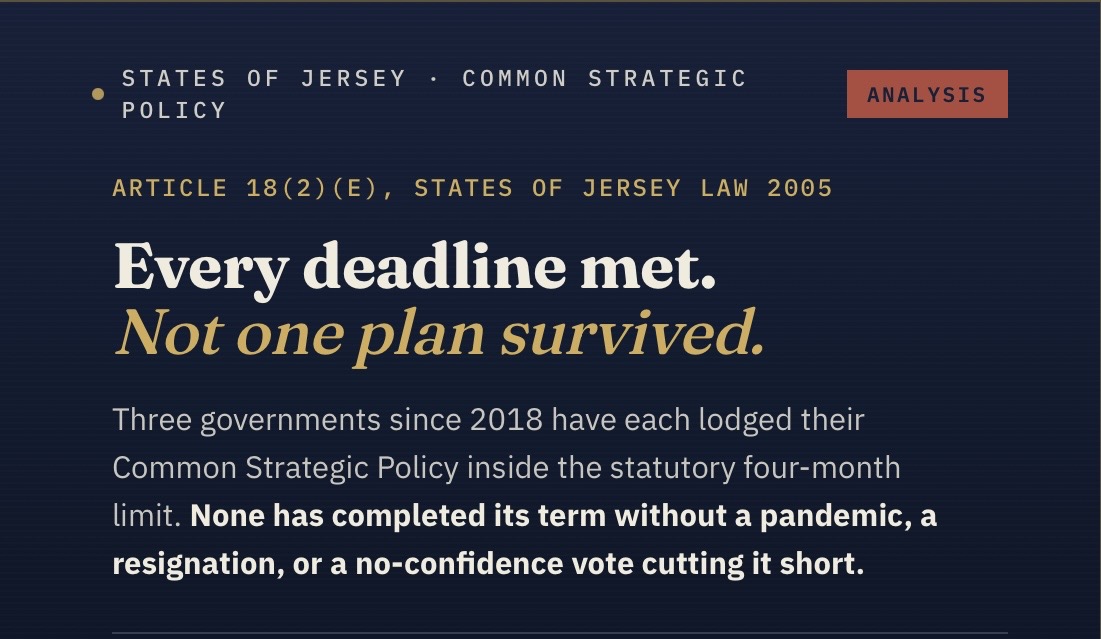
It sounds like a technicality. In practice, the CSP is the single document against which an entire government's four years or, increasingly, two years, get judged. And Jersey's experience since 2018 tells an interesting story: the Island has never actually breached the deadline, but "on time" and "well delivered" have turned out to be very different things. The Rule, and Why It Exists The requirement sits within the Council of Ministers' core statutory functions alongside co-ordinating policy across departments and agreeing matters that cut across more than one ministerial portfolio. The logic is straightforward: a newly formed government should not be allowed to drift without a stated set of priorities, and the Assembly, through Scrutiny should get an early, formal opportunity to interrogate what those priorities are before the money attached to them gets voted through in the Government Plan. That sequencing matters. The CSP is meant to come first, conceptually if not always in practice, with the Government Plan then translating priorities into pounds. When the two have drifted apart, as they did during the 2024 mid-term change of government, the disconnect has been felt in Scrutiny commentary. Three CSPs, Three Different Governments CSP 2018–22 (Le Fondré). Following the 2018 election, Senator John Le Fondré's Council of Ministers lodged its Proposed Common Strategic Policy (P.110/2018) on 3 October 2018, roughly three and a half months after ministers took office, comfortably inside the statutory window. The document set five strategic priorities built around children's life chances, the economy, the environment, income inequality and islander wellbeing, and Le Fondré framed it as a cross-party effort to make the Island "stronger, safer, healthier and more self-confident." It was heavily amended in the Assembly, including a fourth amendment lodged by the Corporate Services Scrutiny Panel in late November 2018, a sign that Scrutiny took the document seriously from the outset. Delivery was another matter. The core priorities survived on paper, official reporting later confirmed there was no change to the government's five priorities as the term wore on, but the pandemic derailed huge amounts of planned activity from 2020, and the government itself lost several ministers along the way, including the Education Minister, who resigned over school reopening policy. The CSP outlived the crises that hit it, but its delivery timetable did not. CSP 2022–26 (Moore). The new Council of Ministers was selected by the States Assembly on 11 July 2022, setting a deadline of roughly 11 November. The CSP (P.98/2022) was lodged in early October and reached its Assembly debate on 22–23 November 202, inside the window, but with less room to spare than in 2018. Framed around the idea of Jersey as "a place where everyone can thrive," it set seven priorities. It attracted a dense set of amendments, including contested proposals on divestment from fossil fuels and a stronger housing-crisis framing pushed by Reform Jersey, most of which were resolved through negotiation rather than defeat. This government's CSP was never allowed to run its course. A vote of no confidence removed Kristina Moore as Chief Minister on 16 January 2024, roughly halfway through the four-year term the 2022 CSP had been designed for. Whatever delivery momentum existed was interrupted by a change of administration rather than by failure on its own terms. CSP 2024–26 (Farnham, mid-term). This is the most procedurally unusual of the three, because it wasn't triggered by a general election but by a no-confidence vote. Lyndon Farnham was elected Chief Minister on 25 January 2024, and his Council of Ministers lodged the Common Strategic Policy 2024–2026 (P.21/2024) on 9 April, around ten weeks later, the fastest of the three cycles and well within the statutory four months. Because it came mid-term, it was deliberately scoped down: twelve priorities (a thirteenth, the Carbon Neutral Roadmap, was added by Assembly amendment) built around tangible, near-term outcomes, living wage transition, GP fee reductions, the Overdale hospital, school meals, rather than a long narrative vision. Farnham was explicit that he wanted to avoid what he called "extensive unproductive narrative" in favour of measurable action. On delivery, this is the CSP with the clearest paper trail so far, partly because so little time has passed and partly because the government itself has been vocal about it. By the government's own account to the Assembly, nutritious school meals reached all non-fee-charging primary schools, the old Overdale healthcare buildings were demolished, planning permission for the new hospital was secured, a teachers' pay settlement was agreed, and Jersey's first Sustainable Finance Action Plan was launched. Two members voted against the final document and one abstained, modest opposition by Jersey's consensus-driven standards, but a reminder that even a "no unproductive narrative" CSP still generates dissent on substance. The Pattern Three cycles, three governments, and one consistent fact: nobody has missed the four-month deadline. That's a genuine institutional strength, the mechanism itself works as designed. What's less consistent is what happens after lodging. Every single CSP in this period has been disrupted by something outside its own control — a pandemic, a vote of no confidence, a mid-term change of government, that either derailed delivery or truncated the document's own lifespan before its term was up. Jersey has essentially never had a full, uninterrupted four-year run of a single CSP since the mechanism in its current form took hold. That's arguably the more important story than the lodging deadline itself: the CSP process is procedurally sound but structurally fragile, vulnerable to any disruption to the government that authored it. What Comes Next The 2026 general election, held on 7 June, produced an outcome that reframes the question. Lyndon Farnham was the only States Member nominated for Chief Minister when the new Assembly met on 19 June, and by 1 July his full slate of ministerial nominees had been elected, with only two contested (Economic Development and, procedurally, a new standalone Planning Minister role still to be filled). This is, in other words, largely the same government continuing, not a new administration starting from scratch. That continuity is the strongest signal available for what the next CSP, due by roughly late October 2026, will look like. A few reasonably confident predictions: - Carryover, not reinvention. Expect the Overdale hospital, cost-of-living measures, GP fee reductions and the living wage transition to reappear largely unchanged, unfinished business from 2024–26 rather than new commitments. - Planning gets structurally elevated. Creating a dedicated Planning Minister role, separate from Environment, is a stronger signal than any manifesto line, it suggests planning reform will carry more institutional weight in the next CSP than it did in the last one. - Growth language sharpens. The contested Economic Development election was fought explicitly over Jersey's stagnant growth record since 2000. Expect the next CSP to lean harder into economic growth and productivity than its more service-delivery-focused predecessor. - Fiscal discipline gets more prominent billing. The incoming Treasury Minister's public commitment to rebuilding reserves and not increasing spending without matching income suggests the next CSP's tone on public finances will be noticeably firmer. - The accountability gap probably still won't feature. None of the three CSPs since 2018 has addressed the governance question raised by P.1/2018 and P.28/2019, the absence of a formal mechanism for individual Ministers to set objectives for, or review, senior officials under the Principal Accountable Officer model. There's no strong signal this changes in 2026, though it remains exactly the kind of gap that Scrutiny amendments have previously been used to try to close after lodging, rather than before. If the pattern of the last three cycles holds, the document itself will almost certainly be lodged on time. The real test, as it has been every time since 2018, will be whether this is the CSP that finally runs its full course without an election, a resignation or a crisis cutting it short.
Discussion (0)
Log in to join the discussion
No comments yet. Be the first to discuss this article!