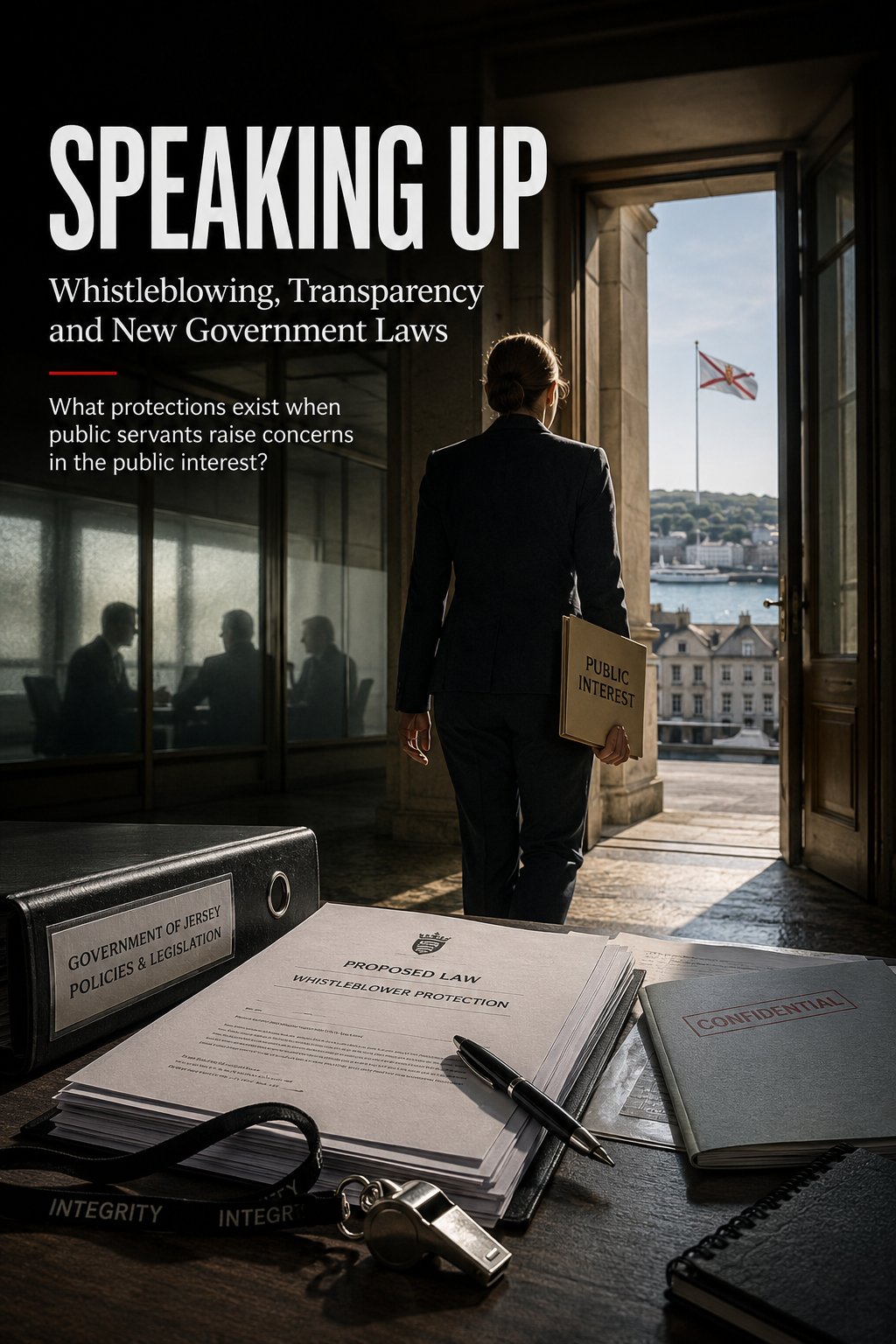
Boxing it off before the bell: Jersey's last whistleblowing hearing — and the law that followed
On 4 March 2026, with a general election weeks away, the Corporate Services Scrutiny Panel sat down for what it openly described as a tidying-up exercise. The Chair, Deputy Helen Miles, told the Chief Minister the panel wanted to settle the question of whistleblowing and grievances so it could go into the panel's legacy report — a final account of unfinished business handed to whoever came next.
What the hearing produced was less a verdict than a snapshot: a system caught mid-reform, with officials able to point to real changes while the panel kept finding the seams where those changes had not yet closed. Twelve days later, the picture shifted again — when the government published a draft whistleblowing law that went further than anything the witnesses had hinted at across the table.
A bigger team, and a new policy going live
The headline from the government side was resourcing. The Chief Minister, Deputy Lyndon Farnham, said the pool of designated officers handling these cases had doubled from two to four — now including the Chief People Officer and the Chief Officer of the Cabinet Office — and that the number of trained investigators had grown from ten to twenty, drawing on a mix of internal staff, newly recruited zero-hours investigators, and external contractors.
Chief People Officer Lesley Darwin confirmed a revised whistleblowing policy was due to go live that very week, accompanied by a communication push to all staff. The most concrete structural change: every department would now have to name a whistleblowing protection officer, a designated colleague staff can approach — including in a different department if they would rather not raise something close to home.
Crucially, the Chief Internal Auditor is no longer the default destination for concerns. Darwin said that role had been narrowed back to fraud and health-and-safety matters following feedback from the Comptroller and Auditor General. The panel had repeatedly questioned why a teaching assistant with a safeguarding concern, for instance, should ever have been expected to engage with an internal auditor at all.
The case behind the reforms
Much of the reform momentum traces to one high-profile dispute: the row between government and the Association of Educational Psychologists over the treatment of educational psychologists within the Children, Young People, Education and Skills department.
Officials acknowledged the case had been mishandled procedurally. It was a tangle of whistleblowing and grievance, and the decision to let the whistleblowing strand take precedence added delay and complexity, leaving the people involved further aggrieved. Deputy Catherine Curtis reminded the witnesses that the union representative had, at the time, said she had not seen this level of incompetence in her 30-year career. The Chief Minister's response was to point forward — to lessons learned and resources added — rather than to relitigate the case.
The episode is the reason "triage" became the watchword of the new approach: sorting a concern at the front door into whistleblowing, grievance, dignity-and-respect, or something else entirely, before it heads down the wrong track.
The gaps the panel kept finding
For all the progress on offer, the panel surfaced a series of unresolved tensions.
A late submission from the Jersey Care Commission — which officials admitted they had received only the day before — flagged that the policy gave staff no comprehensive list of external bodies they could report to, no clear regulatory contact information, and insufficient explanation of when an external disclosure is lawful and protected. It also noted the policy did not clearly cover contractors, agency workers, volunteers or former employees. Officials said the new policy addressed some of this and that anyone can raise a concern through the NAVEX "speak-up" line anonymously, but conceded the protections point had not specifically been dealt with and would now be revisited.
There is also no formal appeals process. Once a whistleblowing case is closed, Darwin confirmed, it is closed — though staff dissatisfied with the outcome are signposted to external bodies such as the Care Commission, the Children's Commissioner or the Commissioner for Standards.
And the panel pressed, more than once, on record-keeping. Deputy Miles asked whether investigatory meetings might be audio- or video-recorded to protect the integrity of evidence, particularly where cases could end up at tribunal. Officials were reluctant, citing prior advice that this was not the best route for an employment matter, and pointing instead to the existing system where both sides can amend meeting notes and, failing agreement, file competing versions.
What's working: the Freedom to Speak Up Guardian
One initiative drew consistent praise from the government bench: the Freedom to Speak Up Guardian introduced in the health service following Professor Hugo Mascie-Taylor's review. Chief Officer Paul Wylie, who line-managed the role in its early days specifically to keep it independent of the health service, described genuine engagement from the leadership team and the new Chief Nurse, an active presence walking the hospital floor and holding open-door surgeries, and a monthly report to the Health Board.
Assistant Chief Minister Deputy Malcolm Ferey suggested the model could translate to an educational setting, given the overlap between health and education, though officials were cautious about rolling it out wholesale across very different departments.
The legislation question — handled with care at the table
The most consequential thread was, at the hearing itself, left deliberately half-told. The Jersey Employment Forum had published 24 recommendations on whistleblowing in June 2025, and the Minister for Social Security, Deputy Lyndsay Feltham, was due to bring a report to the States on 16 March 2026.
Ferey would not pre-empt it, comparing the prospect to opening presents before Christmas. But he offered a telling caveat: the Forum's consultation had drawn responses from only a small cohort, mostly the usual interested parties, and could arguably have been cast wider. The Forum had concluded that having a whistleblowing policy should remain voluntary rather than mandatory — a recommendation the panel clearly wanted to probe. Ferey and the Chief Minister both signalled the report would mark the start of a process rather than the end of one, with the substantive decisions falling to the next Assembly.
That framing — cautious, incremental, voluntary — is worth holding onto, because what the government actually published less than a fortnight later was considerably bolder.
What happened next: a draft statutory law
On 16 March 2026, Deputy Feltham presented to the States not merely a report but a full draft law: the Protected Disclosure (Protection of Whistleblowers) (Jersey) Law. If enacted, it would give Jersey statutory whistleblower protection for the first time, bringing the Island closer to the UK, the Republic of Ireland and the Isle of Man. The initiative originally stems from a proposition by Deputy Carina Alves, agreed by the Assembly back in June 2023.
The draft was published for stakeholder feedback rather than lodged for debate. Its main features:
It covers all employees across all sectors. To be protected, a worker must make a "protected disclosure" about wrongdoing — defined broadly to include criminal offences, breaches of legal duty, environmental harm, risks to the maintenance of law, and attempts to cover up any of these. Disclosures must go to one of a defined list of "receivers" — including the body being reported, a States Member, the Comptroller and Auditor General, the Financial Services Ombudsman, the JFSC, and the Children's, Information, Standards and Charity Commissioners — who must record the concern and take reasonable steps to investigate. It goes further than UK law in places, extending protection to people who have expressed an intention to disclose, encouraged others to do so, or supplied supporting information. Workers providing a service, such as contracted cleaners, and police officers reporting the States police, are covered. Maximum compensation is set at £30,000, aligned with existing discrimination law, and the draft prohibits contracting out.
Local lawyers were quick to note the limits. Walkers' employment team observed that the "receivers" mechanism arrived unexpectedly and went beyond what the Employment Forum had recommended — yet, at the same time, the law would not require employers to have a whistleblowing policy at all, and carries no penalty for a receiver who takes a report and fails to act on it. Protection for those who go to the media is narrow, applying only where a substantially similar disclosure has already been made through the proper channels — a gap with obvious resonance given recent local cases, including the 2024 dispute in which ambulance staff said they faced disciplinary threats after raising safety concerns publicly.
In short: the system that the scrutiny panel examined on 4 March — voluntary policy, no statutory backing, the Chief Internal Auditor only just stepped back from the front line — was, within two weeks, overtaken by a proposal to put whistleblowing on a legal footing entirely.
Where it stands now
The draft law was never going to be debated in the dying days of the term, and it was not. That leaves its fate to the new Assembly.
Jersey went to the polls on 7 June 2026 — the first Sunday election in modern memory, and the first since 2018 to put nine Island-wide senators back on the ballot. The newly elected Assembly meets on 19 June to choose a Chief Minister for the 2026–2030 term. It will be that government, and Deputy Feltham's successor at Social Security, who decide whether the Protected Disclosure Law is carried forward, amended, or left to lapse.
For a panel that set out in March simply to "settle" whistleblowing before handing over, the timing is almost too neat. The reforms it scrutinised were already being overtaken by events as it spoke; the much larger question — whether any of this should carry the weight of law — now sits with people who were not in the room. As Deputy Miles put it in closing, much of it "will not be for us" but for a new panel, and a new Assembly, to take up.
Sources
- States Assembly of Jersey — Corporate Services Scrutiny Panel: Whistleblowing and Grievances, transcript, 4 March 2026
- Government of Jersey — "Draft whistleblowing law report presented to the States Assembly" (16 March 2026)
- Government of Jersey Blog — "News this week…" (20 March 2026)
- Walkers — "Jersey's draft whistleblowing law"
- Walkers (via JD Supra) — "Jersey's draft whistleblowing law: Key features and first impressions
- Mondaq — "Jersey's Draft Whistleblowing Law: Key Features And First Impressions"
Discussion (0)
Log in to join the discussion
No comments yet. Be the first to discuss this article!