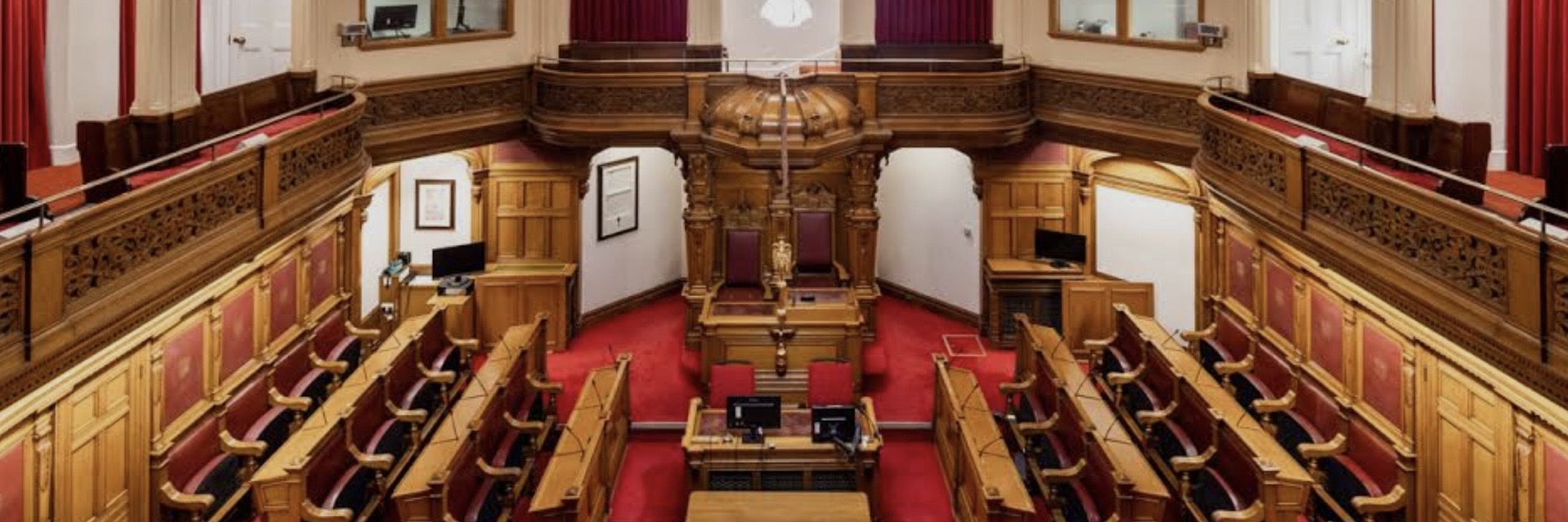
Jersey Elects Its Chief Minister: A Day of Vision, Scrutiny and Unfinished Business
The States Assembly today sat to elect Jersey's next Chief Minister, with the only candidate being Senator-Elect Lyndon Farnham addressing Members with a statement of intent before facing an hour of questions that tested, probed and occasionally punctured the vision he had set out. What emerged was a picture of a politician of considerable experience and political skill, navigating the gap between ambition and commitment with varying degrees of success.
The Speech: Ambition Without Answers?
Farnham's opening statement was, in many respects, a masterclass in political triangulation. He positioned himself simultaneously as the candidate of fiscal discipline and the enemy of austerity, the champion of economic growth and the defender of public services, the pragmatist who delivers and the visionary who looks outward with optimism and ambition. It is a difficult tightrope to walk, and the Assembly was watching closely for where the weight actually falls.
At the heart of the statement is a familiar tension in Jersey politics: how do you restrain public spending while continuing to invest in healthcare, housing and infrastructure? Farnham's answer, eliminate inefficiency, modernise services, reduce consultant dependency, embrace technology, is not wrong, but it is also not new. These commitments have featured in Jersey government statements for the better part of a decade. What remains conspicuously absent is any account of what happens when the efficiencies don't materialise fast enough, or when the pressures exceed what productivity gains can absorb.
On the economy, Farnham's instincts are broadly pro-growth and pro-finance, with welcome acknowledgement of emerging sectors, digital technology, fintech, the blue economy, sustainable energy. The reference to the recent competitiveness review of the financial services sector signals that he understands the industry's anxiety about Jersey's relative standing. But renewing Jersey's appetite for growth is a mood, not a plan. The Assembly will want to know what specific levers Government intends to pull.
Housing and cost of living received their obligatory passages, with the right language about supply, first-time buyers and removing barriers to construction. Again, the diagnosis was sound; the prescription thin. Accelerating delivery of approved developments is something every Jersey government has pledged. The question is why it hasn't happened at the pace required, and what Farnham proposes to do differently.
Perhaps the most politically significant section was the one on accountability and delivery. The commitment to strengthening accountability and ensuring Ministers and departments are held to clear objectives will resonate with those who have long argued that the governance framework established by P.1/2018 and P.28/2019 created a structural gap between ministerial authority and senior official responsibility. Whether Farnham intends to address that gap substantively, or simply manage around it, remains to be seen.
What the speech communicated most clearly was continuity. Farnham is not offering a break from the current direction; he is offering a more disciplined version of it. For some in the Assembly, that will be reassuring. For others, it will be precisely the problem.
---
Questions from the Assembly
Following the statement, Members put the candidate to the test on the specifics his speech had notably left open. What followed was one of the more searching question sessions in recent memory, driven in no small part by a newly elected Reform Jersey group that arrived with an evident appetite to press for answers.
---
Revitalising St Helier — Connétable of St Helier
The Connétable of St Helier opened proceedings by pressing Farnham on whether the incoming Government would maintain the commitment to town revitalisation that had featured explicitly in the previous Common Strategic Policy. It was a pointed question, a reminder that priorities can quietly disappear between one government and the next without any formal decision being taken to drop them. Farnham was unambiguous: the commitment would continue.
She pressed further, requesting a meeting next week to discuss immediate practical priorities for the town and asking whether Farnham was considering appointing a dedicated Minister for St Helier. Farnham's response drew laughter across the Assembly. Noting the Connétable's rather direct approach to securing the meeting, he remarked with good humour that it appeared he had little choice in the matter. It was a small but telling moment, Farnham's ability to disarm with wit and warmth is one of his genuine political assets, and it was on easy display early in proceedings.
---
Child Poverty — Deputy Louise Doublet
Deputy Louise Doublet brought the chamber's tone sharply back to earth. Speaking with evident conviction, she confronted Farnham directly with the Children's Commissioner's finding that one in four children in Jersey are living in poverty, a statistic she described as a major red flag for the Island's society.
Farnham acknowledged that meaningful work had already been undertaken to support children and families, but accepted that more remains to be done. When pressed for specifics, however, he declined to set out a concrete plan, stating that the detail would need to be worked through with stakeholders before any commitments could be made.
It was a cautious answer, and arguably the right one in procedural terms, given that he had not yet been formally elected. But for Deputy Doublet and others who have long argued that child poverty in Jersey is not a future concern but a present crisis, the response will have felt measured to the point of inadequacy. A quarter of the Island's children living in poverty is not a policy nuance; it is a structural failure. The Assembly will be looking to see whether that urgency is reflected when the Government Plan is eventually brought forward.
---
Austerity and Fiscal Discipline — Deputy Coles, Reform Jersey
The first question from the newly-formed Reform Jersey party came from Deputy Coles, who zeroed in on what is perhaps the central contradiction in Farnham's prospectus. If fiscal discipline is the watchword of the new Government, how does that square with protecting Islanders who simply cannot absorb cuts to the support they depend on? Coles asked Farnham to make it explicit to every member of his incoming Council of Ministers that financial restraint cannot come at the expense of the most vulnerable.
Farnham did not hesitate. He committed to maintaining the approach taken by the previous Government in supporting those in need, and was clear that he had no intention of withdrawing support from Islanders who rely on it. The caveat, however, was significant: help must be properly targeted.
That word, targeted, will bear watching. In the hands of a government genuinely committed to protecting the vulnerable, targeting means ensuring support reaches those who need it most. In the hands of a government under fiscal pressure, it can become the language through which eligibility is quietly narrowed. Reform Jersey will be well aware of that distinction, and Deputy Coles's early intervention signals that his party intends to hold the Government to the more generous interpretation.
---
Democratic Standards and Jurisdictional Reputation — Deputy Feltham, Reform Jersey
Reform Jersey's second intervention came from Deputy Feltham, who framed her question at a higher constitutional register than most. She asked whether Farnham accepts that Jersey's international reputation, as a well-regulated, transparent and stable jurisdiction, rests not only on the quality of its legislation and regulation, but on the world's confidence in its democratic standards. Farnham agreed, calling on all Members of the new Assembly to bear that in mind in everything they do.
She then pressed with a sharper follow-up: would the Chief Minister agree that opaque political interference is not a minor procedural matter but a genuine reputational risk for the Island? The question almost certainly has roots in the recent election campaign, where concerns were raised about the conduct and transparency of certain political activity, concerns that fell particularly heavily on candidates aligned with Reform Jersey. By linking the issue to Jersey's external reputation, Feltham elevated it beyond internal party grievance into a question of jurisdictional credibility.
Farnham's response was characteristically direct in style if carefully bounded in substance. He stated plainly that he does not agree with opaqueness — preferring things in black and white, and pointed to the forthcoming report from the Electoral Authority as the appropriate vehicle for addressing any concerns. It was a neat sidestep: principled enough in tone to avoid controversy, but carefully avoiding any specific acknowledgement of what may or may not have occurred. Whether the Electoral Authority's report, when it arrives, prompts meaningful action will be the real test.
---
Economic Growth — Deputy Curtis, Reform Jersey
Deputy Curtis pressed Farnham on the specifics of his economic growth agenda. The answer was supply-side in its instincts, removing barriers to business, cutting regulation, making it easier and less costly to employ people, alongside an announcement of his intention to appoint a dedicated economic minister with a sharp focus on those objectives.
The direction of travel is clear, and the business community will welcome the rhetoric. But the answer invites scrutiny. Deregulation and reduced employment costs can stimulate growth, but they can also shift risk and cost onto workers and the public purse if not carefully calibrated. For a chamber that had just heard about child poverty and the need to protect the most vulnerable, the tension between a leaner regulatory environment and adequate social protections is live, not abstract. The appointment of a dedicated economic minister is the most concrete commitment Farnham made in this session. Who fills that role, and what mandate they are actually given, will say more about the Government's economic direction than any statement from the despatch box.
---
Fort Regent — Deputy Stephenson
Deputy Stephenson raised the future of Fort Regent, one of St Helier's most totemic planning questions. Farnham indicated that the vision has been set out and communicated, with particular emphasis on engagement with schoolchildren, and committed to the site being back open by 2030.
When Stephenson followed up by asking how the project would be funded, Farnham confirmed that the £100 million project would be financed through borrowing.
It is a noteworthy answer, and one that sits in some tension with the fiscal discipline framing that opened his statement. Farnham has been careful to say that borrowing should be used principally for long-term capital investment that benefits future generations, and Fort Regent could reasonably meet that test. But £100 million is a substantial commitment, and it will form part of the backdrop against which every other spending decision this Government makes will be judged. Farnham has now attached a price tag to one of his Government's flagship projects on day one, and that figure will follow him to every Government Plan debate for the next four years.
---
The Environment — Deputy Hilary Jean
Deputy Hilary Jean raised what was, by her own implicit framing, a conspicuous absence. The opening statement had said virtually nothing about the environment, and she wanted to know how Farnham intends to ensure that environmental protections are not quietly eroded in the pursuit of economic growth and fiscal savings.
It was a well-aimed question. When a Chief Minister's prospectus is built around deregulation and cutting costs, the environment is precisely the area where protections are most vulnerable to being reframed as obstacles.
Farnham opened with a broad appeal to consensus, suggesting that no Member of the Assembly would fail to take Jersey's environmental responsibilities seriously. The more revealing part of his answer was the caveat that followed. He pointed to affordability as a necessary consideration, citing the previous Assembly's plan to phase out fossil fuel vehicles as an example of where ambition had run ahead of what Islanders could realistically absorb.
It was a politically shrewd example, but the principle he was establishing is a broad one. Affordability is a legitimate constraint on environmental policy, but it can also become a routine justification for delay. The question Deputy Jean was really asking is whether environmental protection will be treated as a floor, a non-negotiable baseline, or as a variable adjusted when other pressures mount. Farnham did not quite answer that.
---
Cost of Living — Deputy Poree, Reform Jersey
Deputy Poree pressed Farnham on his main priorities for tackling the cost of living. His answer was notable for its candour before it was notable for its solutions. He acknowledged upfront that the Government's ability to influence prices is genuinely limited, a consequence of Jersey importing approximately 98% of its goods. His proposed levers were efficiency improvements, cutting costs, reducing regulation and promoting competition.
The honest acknowledgement that this is very difficult and that Government control is limited may actually be more valuable to Islanders than a confident list of pledges that cannot be delivered. But it does leave a gap. If Government cannot directly move the dial on imported goods prices, the question becomes what it can do to strengthen household incomes and reduce domestically-controlled costs such as utilities, rates and public service charges.
---
LGBTQ Rights and Children's Rights — Deputy Doublet
Deputy Doublet returned with two questions on rights. On LGBTQ rights, Farnham's commitment was direct and unequivocal. On the follow-up, whether he would commit to fully incorporating the United Nations Convention on the Rights of the Child into Jersey legislation, his response was more cautious. He indicated he would need to refamiliarise himself with the detail of the Convention and suggested that full incorporation would ultimately be a matter for the Assembly rather than a decision for him alone.
It was an honest answer about process, but it risks being read as a deferral. The UNCRC has been under discussion in Jersey for years. Deputy Doublet, who has pursued this issue with considerable persistence, will not be letting it rest.
---
Housing Growth and Community Infrastructure — Connétable of St Helier
The Connétable returned to ask how housing growth in St Helier will be matched by the community infrastructure that makes urban living viable, parking, parks, cafes and shops. Farnham pointed to the Investing in Jersey programme he initiated during the previous term. It is a tangible reference point, but the Connétable's question was really about pace and matching, whether infrastructure investment keeps up with housing delivery rather than lagging years behind it. Islanders who have watched new apartment blocks rise in St Helier while green space and local services have failed to keep pace will want more than a programme name.
---
Whistleblowing Legislation — Deputy Feltham, Reform Jersey
Deputy Feltham returned to ask whether the Chief Minister would commit to introducing whistleblowing legislation. Robust whistleblowing protections are widely regarded as a cornerstone of accountable government, the mechanism by which internal wrongdoing can be surfaced without the individual bearing all the personal and professional risk.
Farnham declined to make a personal commitment but said he would bring the matter to the new Council of Ministers. It was a carefully calibrated response, neither a rejection nor an endorsement. But for Deputy Feltham and others pressing for greater transparency in Jersey's public institutions, the absence of a personal steer will be noted. Whether this reaches the Government Plan, and with what priority, will be an early indicator of how seriously the new administration takes its stated commitment to transparent government.
Read our Article on Whistleblowing ---
Lessons in Office — Deputy Wilson
Deputy Wilson posed perhaps the most reflective question of the session, asking what Farnham had actually learned in office about controlling public expenditure, and what he would do differently.
Farnham's answer was unusually candid. He acknowledged that the job is one where learning never stops, but the substance of his reflection was more significant: when the Government took office, the expansion of public sector staffing during Covid was not slowed or reversed nearly quickly enough. The headcount had grown, the emergency had passed, and the machinery of government had not moved fast enough to recalibrate.
It was a rare moment of institutional self-criticism from a sitting Chief Minister seeking re-election, and it deserves to be taken seriously. The public sector wage bill has been one of the most persistent drivers of Jersey's spending pressures. The question that follows naturally is what structural changes he now intends to put in place to ensure the same lag does not occur again.
---
Public Complaints Handling and the Ombudsman — Connétable of St Mary
The Connétable of St Mary raised Jersey's long-running failure to establish a robust and independent mechanism for handling complaints against public services, referencing the work of former Deputy Moz Scott whose report made the case for a public services ombudsman.
Farnham acknowledged his close involvement with Deputy Scott during the development of that report and said he supports the principle behind it. The caveat was familiar: cost. It is a tension that recurs throughout this session. The difficulty with applying a cost lens to complaints handling is that the absence of an independent ombudsman also carries a cost, in unresolved grievances, eroded public trust and reputational damage. At some point, the principle Farnham says he supports will need to be converted into a budget line.
---
Residential Tenancy Law — Deputy Lee Carpenter, Reform Jersey
Deputy Lee Carpenter made his mark early, using his very first question since being elected to press Farnham on the new residential tenancy law. Farnham's answer was unambiguous: he fully supports the law and has no intention of making any changes to it.
It was one of the cleaner, more direct commitments of the entire session. The residential tenancy law has been contested, with landlord interests pushing back during its development. Farnham's explicit commitment to leave it intact sends a clear signal that those protections will not be quietly unpicked. For a newly elected Deputy asking his first ever Assembly question, it was a well-chosen target, and the answer he received gives him something concrete to hold the Government to.
---
Public Sector Pay — Deputy Poree, Reform Jersey
Deputy Poree returned to ask whether the Chief Minister would guarantee public sector pay rises in line with RPI. Farnham declined to make a public commitment, citing live pay negotiations, a procedurally sound position that no experienced Chief Minister would abandon. He noted, however, that for each of the last three years, public sector pay had been delivered at RPI plus one percent, offering an implicit answer without constituting a formal guarantee.
How the new administration navigates the gap between fiscal restraint and fair pay for public servants will be one of the defining tests of whether its commitment to protecting the vulnerable extends to those who deliver the services they depend on.
---
Readiness for Difficult Decisions — Deputy Voisin
The Bailiff introduced Deputy Voisin with a wry reference to him as a new old member, drawing laughter from the chamber. Farnham matched the moment, welcoming Voisin back warmly and observing that while the Deputy had returned somewhat greyer of hair, the same could be said of himself, a remark that brought further laughter from the benches.
But beneath the warmth, Voisin's question was serious: how prepared is Farnham genuinely to make the difficult decisions that delivering on his ambitious statement will require? Farnham's answer was confident without being boastful, he said he is as prepared as anyone in the Assembly could be, an implicit appeal to his experience as the incumbent rather than a claim he could not substantiate. Readiness for hard decisions is ultimately demonstrated in the decisions themselves. The Assembly will be watching.
---
Relations with Europe — Deputy Morel
Deputy Morel raised a question with considerable economic and geopolitical weight, arguing that the Assembly had been strangely quiet for six years on Jersey's relationship with Europe, despite the significance of that relationship for fisheries, farming and trading links in the post-Brexit landscape.
Farnham pointed to work already undertaken alongside Deputy Gorst and Deputy Morel himself in building European relationships. The more interesting element of his answer, however, was the hint that Deputy Gorst may continue that work as the next Minister for External Relations, an early signal about the shape of the incoming Council of Ministers before it has been formally constituted. If confirmed, it would represent continuity in an area where continuity has real diplomatic value.
---
Character Reference for Former Guernsey Chief Minister — Deputy Tadier
Deputy Montfort Tadier brought the most politically charged moment of the session, asking whether the former Minister for External Relations had consulted Farnham before providing a character reference for the disgraced former Chief Minister of Guernsey. Farnham's answer was brief and unambiguous: there had been no discussion.
It is a significant disclosure. A character reference provided by a Jersey Minister for External Relations in relation to a high-profile case involving the political leadership of a neighbouring Crown Dependency is not a private matter, it carries the weight of Jersey's institutional reputation and touches directly on the questions of transparency and democratic standards raised earlier by Deputy Feltham. That such a step was taken without any consultation with the Chief Minister raises questions about the discipline and collective responsibility of the previous Council of Ministers. Farnham's candour in confirming the lack of consultation was notable, but the answer also invites further questions about what his view of that decision actually is.
---
Education as Economic Infrastructure — Deputy Li
Deputy Li offered what she described as a simple yes or no question: would the Common Strategic Policy treat education as economic infrastructure? To classify education as such is to make the case that investment in learning is not a social spending commitment but a foundational element of economic productivity, with the same long-term rationale as roads or broadband.
Farnham declined the yes or no, pivoting instead to the specific challenge of children with special educational needs and the importance of supporting them into the economy. It was a humane response, but it sidestepped what Deputy Li was actually asking. The relationship between what Jersey teaches its young people and what its economy can achieve in the next generation is not a peripheral consideration, it is central to almost everything Farnham said he wants to deliver.
---
Government and the Charity Sector — Deputy Romeril
Deputy Romeril raised the relationship between Government and Jersey's charitable sector, a partnership that has not always been comfortable, and asked whether Farnham would commit to strengthening it. Farnham's answer was positive but came with an undertone worth examining. He indicated that when looking to reduce public expenditure, the charitable sector is an area he intends to examine, on the basis that charities consistently deliver services more efficiently than Government.
The sentiment is not without foundation, but the framing of the charity sector primarily through a cost-saving lens is one that the sector itself will view with caution. There is a meaningful difference between a Government that partners with charities because it values what they do, and a Government that turns to them because it is looking to reduce its own spending commitments. The former builds genuine relationships; the latter risks transferring public service obligations onto organisations dependent on voluntary funding and goodwill.
---
Conclusion: A Chief Minister Elected, but Questions Remain
There was no need for a vote at the end as there was only one candidate, so Lyndon Farnham was returned as Chief Minister. He leaves the chamber with a mandate, a vision and an Assembly that has served notice, through more than an hour of sustained, serious questioning, that it intends to hold him to account for it.
The session revealed a politician of considerable skill: warm enough to disarm, experienced enough to know when not to commit, and candid enough on occasion to acknowledge failure. But it also revealed the fault lines that will define the next four years. The tension between fiscal discipline and social protection. The gap between environmental aspiration and economic priority. The distance between acknowledging principles, on the ombudsman, on whistleblowing, on the UNCRC, and converting them into action.
Jersey has a new Government. The hard part begins now.
---
States Assembly, 19 June 2026
Discussion (0)
Log in to join the discussion
No comments yet. Be the first to discuss this article!